Food security work has two clocks running at once. The urgent clock measures whether a household eats this week. The slower clock measures whether it can feed itself through the next harvest. Programmes that only watch the first clock end up repeating themselves every year.
Meeting the urgent need
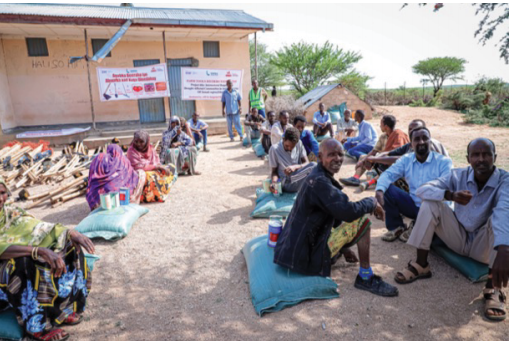
Unconditional cash assistance reached 7,500 households, letting families set their own priorities at the market rather than receiving a fixed basket. Where markets were not functioning, 25,000 individuals received emergency food rations to prevent malnutrition.
Investing in the next season
Alongside relief, 12,000 households were supported with agricultural inputs such as seeds, tools and fertilizer, and 3,500 people were trained on climate-smart and modern farming techniques. Vocational skills training gives households a second income source that does not depend on rainfall.
Self-reliance is not an exit strategy we write at the end. It is the design decision we make at the start.